lördag 16 november 2013

Unity the game maker and codeacademy

Svitri noticed that they had a 3hour course in Unity at HumLab, so I took the chance to check it out. I thought it might be easy enough to make our game in it.


games made in unity


Totally worth it!!!

In 3 hours I learned to make a first person game where you could walk around with a flashlight, touch a cube to make it explode and throw around objects on fire. We've decided to ditch construct 2 and use unity as our engine to make the game. Unity works with c#, Boo and javascript so we have decided to learn javascripting.


ugly game with wooden grass


We use Codeacademy, a phenomenal site to learn the basics! Anyone just slighty interested in programming HAVE to check it out. It's very easy to learn. They use gamification and have made very simple exercises which you finish in seconds so that you really feel that progress you make.

writing 34 is very easy
I'm beginning to think that maybe that approach is better than mine for teaching via interactive artifacts.

I scanned through the course and I see that we'll need to learn additional stuff that's connected to scripting for unity, and all that seems very available in the unity community/forums, it's huuuge. I've begun to understand how unity works and the traditions of scripting for unity, so I hope that in two-three weeks we'll have a good structure and maybe even a very simple alpha of the game.

Visual Novel Toolkit Free

Our story guy Hjalmar likes the idea of visual novels so I've found a great (free) tutorial for making visual novels in the unity asset store. He'll be thrilled, I bet!


I've played around in unity and there is allot of free tutorials and templates (in the assets store) which makes the learning process super-effective. I'm so happy for this.


There is still much work needed to be done besides coding and level design:
  • Taking ca 30 good pictures
  • Drawing ca 10 nice backgrounds
  • Drawing ca 60 good buttons and small images
  • Animate ca 50 objects
  • Recording ca 30 sounds
  • Documenting exactly how many of each is needed

I'm going to make lists of what exactly we need and then like post it on facebook or something and see if folks likes the idea of contributing to the game, that would be awesome.


If anyone you know is interested in making games, feel free to recommend my blog if you think it might help.

Thanks for dropping by!

//Tistou Blomberg, human

lördag 9 november 2013

Concept art: microbots and neurons

I've been working on making levels. Making puzzles for the levels is fun, I used to make levels for Age Of Empires and play against bots.

It takes time though, this is one aspect I really haven't considered. This might push the release date further. It also might not... I've decided to focus on defining the objects that the player will be able to use in the game. I think that if these are made really basic, like minecraft blocks or legos, then it might just be enough to be fun to create alot of stuff yourself.


capsaicin triggering a response and starting the wave-pusher to push it away
I started out making the first level to get a concrete goal for when we start coding (very soon).

Once I did this I felt that I can't decide wheter the first level should introduce a pusher, a laser or something else. So instead I started making some object-concept art. Hopefully that will make it easier to make alot of fun levels!


Woa, that neuron is angry!


A heater heats an area for example.


Twin lasers defending the wild west

Here is two lasers. The strong red one takes more nutrition to use, so a 'fire-charger' has been added. That way if there is just one enemy the neuron will trigger the green one but the red one will just be 'teased' a bit, but wont fire. With time the charger will lower it's energy so the neuron has to tease it again. When you have allot of enemies there will be allot of signals from the neuron and the red laser will charge up and fire. So it will only fire when it's usefull. This 'fire-charger' could be put on other stuff as well such as a rocket launcher or anything.


viruses are bad

Here two red lasers fire and make enormous damage on a square containing a virus.


The dual spin-pusher-brain is the ultimate of undeadlyness!


Here we introduce a 'turner', this could be combined with a pusher or something else to make your own targeting system or something else. Trigger one 'turn-side' and it will turn 90 degrees.

Later on we will add conveyor belts or 'movers' and alot of other sci-fci goodies.

The neurons with extra color is a new idea. The player will need to distinguish a receiving dendrite from a sending axon. Nothing will happen if you connect a dendrite to a nanobot.


So my belief is that if we make these very elementary objects and think about getting as much possibilities as possible we will easily make alot of gameplay for players who like to play and make stuff. A threatening side effect can be that one player finds out some super-effective strategy that allways kills everything. If that happens the game will be less fun and not so challenging for that player. So we will want allot of beta-testing.

We have also checked out umeås universitys HUMlab and they said we can use their sound-recorders, computers and programs to edit sound and allot of stuff! We also talked a little about making some PR to see if some student is interested in joining up. Apparently they have Unity installed and some people has made some games. If we can get a good tutorial or some lessons by some student who has used it, that would be awesome.

We still have no dedicated graphic designer or experienced programmer.

If you are experienced in unity and want to join
or
interested in drawing neurons and nanobots,

and also live in Umeå I'd love to hear from you. Send me some beautiful emails: koncentrera@gmail.com


Now my friends will pop by and we all'll watch starcraft 2 world championship series
(lol all'll)

// Tistou Blomberg, the man behind the computer

lördag 2 november 2013

Level design and effective teaching

I want to catch the player with a hook in the first level but it also has to be simple enough to understand in 1-2 minutes. All this while preparing for more information to be presented in a smooth way.

I want the first level to present the 'whole game' in the first level. So that the player will understand generally what the game is all about.

In the first level I've almost decided to have the player:

Make a neuron out of an embryonic cell
Connect the neuron to a micro-robot
Stimulate the neuron to make the robot shoot
Inject genes into the neuron to develop pain-reception (nocireceptors)
Defend the neuron and embryos against bacteria


I've read a book called "Beyond barbie and mortal kombat" which is a bunch of texts written by different
authors about gaming and gender. I want the game to appeal to both boys and girls, this is hard. The book doesn't present many solutions except having girls in the developing team. I haven't got a hold of any motivated girls so I fail at that point. One text in the book proposes to divide gamplay in masculine and feminine since many girls can like "shooters" for example. I recognize the tower defense gameplay to be classified as "masculine" and will probably appeal masculine players mainly. Hjalmar came up with the idea of having "puzzle"-levels where you think a bit more and that may be a bit less masculine. I also want to show the player a good story (relationship development) since that seems (accoring to some parts of the book) appealing for feminine players. I don't know how well we will pull this one off but we'll try our best. I'd love to have more people with a feminine playstyle on the team. I will definately push to have 50% of testers have a feminine playstyle.

So I am going to put some energy to come up with a simple puzzle and incorporate the story into the first level. Then maybe switch back and forth between playstyles, maybe giving the player the choice of which to use.

There are alot of cells doing alot of stuff
I've thought about having a bilogical "warfare" on the threats to bacteria and such instead of having nano-robots. As I researched immunology today and I got so much info... It's to much to work with right now. It's interesting though!


So I think we'll stick to neuron, micro-sized bots and maybe glial cells.


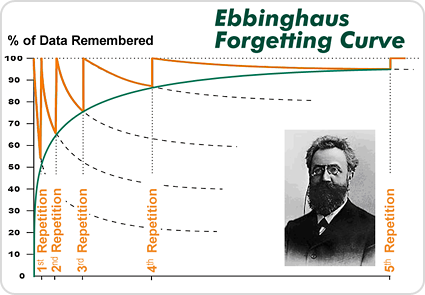
What I really like to incorporate is my ideas about how to facilitate learning. I like Ebbinghaus forgetting curve and I think that one can combine that with making a network of associations between knowledge.

In order to make the new knowledge usefull and memoriable, I want the player to be able to think about it when outside the game and be able to find everything she has experienced in the game.

I believe that memories are formed through connections between neurons by processes like LTP (Long Term Potentiation). We make new connections/associations and the stronger the connection the more likely it is to fire "when you need it". I want the player to get the knowledge and be able to find any knowledge in her network (brain) at any time. So in order for that we need to present the knowledge in a structured way that is easy to navigate through, a way that works good with the natural processes of the brain.

For example:
We present the term "polymodal nociceptors" and we tell our student that it's what we use to experience pain. If this student doesn't know much about the elements that makes up the words and the context it is used it can be very hard for her to remember what it was used for. The connection could just be from this set of letters and sounds to the fact "we use it to experience pain".

Different chemicals stimulating a polymodal nociceptor
If we on the other hand prepare our student with some knowledge this can be easily fixed. We tell her that "poly" is the word for 'many' (http://www.etymonline.com). Like polygon has many edges and polygyny is having many wives. We try to connect this word to different exiting knowledge the student has so that she has greater chance of getting the knowledge when she need it. You may know that innocuous means 'harmless' and in this case 'noci' means harm. We tell her about what a receptor is and we also tell her about modality. In this case we have a "nociceptor" that reacts to many different stimulis; heat, touch and chemical substances. The richer the painting the easier it is to remember, in fact presenting a picture, sound, smell, touch and other things makes all this stuff allot easier (but that's another part of memorization). This is actually quite obvious but I feel that we aren't paying enough attention to the existing knowledge in students when teaching them new stuff. I am no teacher so I don't know what goes on inside their heads but I often feel like I'm supposed to take care of painting the picture myself. Which is fine by me but we could do so much better! And with algoritms that learns what a learner know and doesn't we can present data on a silver platter.


Is knowledge a part of success or success a part of knowledge?


I don't know exactly how to implement this everywhere yet but I see a bright future. In our game we will see to it that we use the Ebbinhaus forgetting curve or other curves so that repetition occurs at the right place. We will try to connect as much info as possible to real life situations and knowledge already existing in the mind of the player. We have had some ideas to see what knowledge the learner is going to build new knowledge on, like having tests to lock up new levels and also ANN (artificial neural networks) to see patterns in playing, memorization and understanding. ANN may be a bit to much computation in this case though.

We will see how much of this we have time to implement but I feel that the most important thing is to learn and to create a system to make good educational games.

I'm going to continue working by making at least 5 complete level-designs. So that we have something to make when we start to make the game. Felix and Svitri has begun to look at construct 2 to see if we can make it with that and we will also start to use the equipment and socialize at Umeå universitys "HUMlabb".


The truth is out there.

Tistou Blomberg signing out.

lördag 26 oktober 2013

Embryology proffessor and task distribution

So yesterday I and Svitri met an embryology proffessor to get some answers.

It was a good idea.

Embyros from cows (taken from the internet)
We met Paul Kingham at Umeå university, he's an excelent and very caring proffessor and he told us about how he makes neurons and other cells from embryos (cow embryos in picture to the right). By letting human embryos grow in different solutions with proteins and substances the embryos develop into different cells. It's kind of like how a human develop their proffession depending on what environment they grow up in. We even got to look at real embryos in his lab! We will come back another time and take with us a camera to take some photos.


Now we know more about how we can depict the making of the cell in the game. There can be some kind of animation where you see bottles with different solutions in them and when you place embryos in them they develop into neurons or glialcells. Paul also directed us towards another scientist who knows more about the exact solutions and does research of how neurons grow their axon in different directions.

Paul had good ideas of how the competition could look like in the game. The competition will be between the evil proffessor(s) and the player. One thing he mentioned is that a big and growin issue in the sience world is that there are people making up numbers to get funding (what you call scientific misconduct). So in the game we will have a person that does this and then get's discovered. I also want the player to feel that they personally win at beeing honest and trusting teammates, I believe that a world where we all cooperate instead of compete will make the society grow faster. But I don't want to trick anyone so we'll strive to keep it as realistic as possible. If you fake evidence and get caught, your publications will probably not be accepted anywhere and your whole career could be totally ruined. That's how it works in the world and I want scientists to take this into account. I believe that the ban of a scientist is not only bad for the scientist, it's bad for us all to loose his competence. So we as a big society should make it easy for scientists to make science by communicating and helping each other instead of competing.

The core of my game is the gameplay, that's the original thing. I've discovered that accepting new teamates made me anxious. I haven't been as great a leader as I hoped I could be. Main issue for me has been that I can't distribute assignments to others since the assignments demand that I do them. Let me clarify. I haven't done all the work needed to be done before starting the development. I didn't realise that I should have been planning more and waiting to get people onboard until the idea was complete. I have decided the gameplay basically and uncountable ideas has been written down and categorized, but it hasn't been enough. I have not until recently decided what actually will happen at level 1 for example. Before that the writer has ofcourse had troubles writing since he doesn't know what he'll be writing for. The graphics haven't been able to be begun with since the items in the game haven't been completely thought up and the same with making sounds. Basically all the things that I could delegate can not be done yet since the task isn't clear yet.

I still have all my energy though. I'm confident this project will reach a good product but as I feared in the beginning, we might not be done before deadline. In the next meeting I will tell everyone that I may need some time to create the gameplay more thoroughly and that I cant delegate so many things yet...

Mindmup
But! I've developed a better view of things thanks to mindmup. I made a mindmap where each bubble is a task. The tasks connected to this task has to be done in order to begin with it. The final task (to the left) is "Launch game". So in order to do that we have to finish the others, and to finish other tasks... and so on until we come to a task that can be done right now. I don't know how this will work out but I think it will make things easier.

Svitri also mentioned that the teammembers that want to do the gamemaking in construct 2 (a gamemaker), can start to learn it and begin to make some groundwork that is ready to be done. Like making the gamearea and the mapcontrols. I will use the mindmap-technology to make more specific tasks and color the done tasks with green to see how we all work forward, I've also shared this through google drive (,we all use google drive to share documents) so that everyone can see the progress.

So right now I'm reading my neuroscience notes and book to decide exactly what will be the goal of each level and how the player will get to know more and more about neuroscience. This is allot how teachers work when they device a teachplan, I'm not educated to be a teacher but I have written a learningplan when I studied "Computergames and learning 1" at umeå university (a course in swedish). That's also where I got in touch with the videogames and learning-book I've mentioned before.

Peace out!
//Tistou Blomberg for trust and communication

lördag 19 oktober 2013

2 new members and allot of graphical interface design!

Photoshopped image of the team
3 additional members has been engulfed by the mission. Anna doesn't have much time but is very interested so she will get some task that will make the game better but is not a crucial element. I will propose either listening to the music in different settings, gather more info about neurology or something else. The other new member is Felix, he likes to program in python and can make music. We concluded that having two musicians is a delicate issue, we don't want what we say in sweden "The more chefs the worse the soup". Even though it's nice to have the same kind of music through the game to make a stable feeling, it could work having different music during the cut-scenes. I don't know, we'll see.

I've also managed to get a graphic designer that's really good, he has no experience in vector graphics but he can make amazing 3d art. I think we'll either ditch the vector graphics or I'll teach him basics to see if he catches on.

To make the graphics we will make some kind of chart of graphics needed. Anybody in the team (and outsiders?) can upload images and we'll give feedback and chose the most fitting images.

The following pictures is about the graphical interface design. I spent the day mostly making cognitive walkthroughs and visualising the game. This is to discover problems and testing design solutions to see what works best. I just drew the pictures to show you some of my early thoughts, I really just go through them in my head and just write down the end result when I'm done (I'm not yet done). I want to show you how I work so I present to you more sketches!


The process of playing is about having a blank sheet with just stemcells and nutrition, then place neurons and nano-robots to make a defence or solve a puzzle. (There will be tower defense levels and puzzle levels).


So the player will go from that ->
To this down here.


This means that the player will spend allot of time placing and rearranging neurons (the blue ones with "tails" connecting to each other), so we want that part to be as pleasurable as possible. Nice juicy soundeffects and an easy to use interface design. So I spend allot of time thinking about how exactly the neurons will be placed upon this micro world.


navigation and stemcell to neuron GUI
You can just look at the pretty pictures since they are not so well adjusted to be understood. In case you really want to know what some of them are about, I'll write.

In this right picture. The bottom 4 frames are about touching and draggin a stemcell from the middle of the screen to where you want to put it. There is allot of way you could do this and it all comes down to what commands the user likes to do. On a touchpad there is touching, dragging, swiping, tapping and when you combine both hands, there is like no end to the possibilities.

The menu that pops up could pop up at the bottom but in this case it pops up right where the stemcell is placed, this is nice since the player wont need to change eye-focus to much or make big movements with the hand. The brain also recognises objects near to each other to be associated (law of proximity) so that makes it more 'logical' and graspable for the brain to accept the idea that this menu is about this stemcell.

After this menu where you might choose to develop this stemcell to for example a neuron, this neuron will need an axon, so touching and dragging would be nice for this. This is pictured in the last frame.

First 6 frames are about navigation. The game area will be bigger than the screen and we can't have enough neurons jammed into one screen (because we need to be able to pinpoint and touch them). So a small map could be shown in the lower left, this could open a map-screen where you touch where of the map you want to see. To quickly change this area without going through the map-screen we could have arrows beside the map-icon to step to the left for example. Instead of this we could have a possibility like touching wherever on the screen can make you "grab" it and move it around like you can do in google maps for example. So when thinking about this and testing playing the game in the mind you can discover the crash of commands when you want to grab a stemcell from the middle and put it somewhere, will the program move the screen or will it grab a stemcell? When the game is full of neurons and stuff and you want to move the screen, you don't want the menues of different neurons to pop upp, you want to move the screen. Looking for an empty square to grab can be frustrating for the user.


Left picture. When a stemcell is placed and you are able to grow an axon from it, this is what I think I will use. Once the stemcell is placed I think that instead of first choosing what the cell will develop to, the program will assume you will be developing to a neuron so even though this 'chosing menu' will appear from the bottom, the possibility is there to save like 0,5 seconds and just grow the axon directly. And this action of pressing a direction to grow it in will turn the stemcell into a neuron and directly start to grow the axon. Also with this we can have a strain of dna at the bottom and if the player wants to develop another kind of cell she can just press that button and she will see that it means that we inject another part of the dna into the cell. This will give the implicit knowledge that different dna-strands changes what happens in a cell. I really like this idea, I think I will use something like this.


So pros and cons are discovered through cognitive walkthrough. Allot of trial and error is what it's about, and I like it. I love to visualize things and just sit meditative style and really fast go through scenarios.

We have also made an appointment with another proffessor who know more about embryology so that we can understand the process of making neurons from stemcells.

The story is going forward and now we have frequent short meeting every week to see if everyone is doing well.


Thanks for checking my blog out, stay curious!

//Tistou Blomberg

lördag 12 oktober 2013

Sketches!, Storywriting by proxy (Hjalmar) and proffessor meeting

Main menu concept art
(pacinian corpuscle, neurons, flashlight, light sensitive cone cell, piano, ear with cochlea and a hair cell)

Unspoilable story
My story writer has not yet made the story, it seems like I wasn't clear enough about what he was
suppose to be doing, actually I don't even know exactly what he is suppose to be doing. I have found it complex to give clear story-writing-instructions that motivate to writing. I decided to meet with him today and begin together to write the story. We made progress! We decided that there will be an evil colleague who does terrible things to the player and in the end the player will... I wont spoil it!

I think he has more ideas of what story to write but I'm not sure, maybe he has to much unclear freedom. I will ask him. We have decided that I write a "level sheet" (see previous post) for every level and then he has to take those components and make a beautiful story. He mentioned that it may be hard to reach mainstream while also have an interesting story, I agree. But I really want the game to be playable by 8 year olds as well as 30 year olds. I'm hoping that Hjalmar will find some super solution like Disney, that reaches a broad audience (for the whole family!). But the most important thing for me is that Hjalmar himself is proud of what he has accomplished. That way he may like to work with me another time also!

I did work on the levels but I am not sure when I will be done with the level-sheets. Deciding what level comes when and what things will happen is a very big workload. It actually makes the whole gameplay.

Svitri and I had a meeting with a clever proffessor at umeå university (Staffan Johansson) and it was very interesting! We had approximately 20 questions and got very good answers. Now we know that drugs may be the biggest threat to the brains thinking in todays society. This will influence the game, we will try to have different drugs affecting the neurons in the game so that people can learn more about what it actually does to neurons. Alchohol, tobacco, LSD, mushrooms... and so on, so forth. We know that you use polylysin on the petridishes so that the neurons stick and don't wash away. They may wash away if you let a stream of toxins or other substances flow over the neuron and this is actually what Staffan does. He knows allot about this. He also gave us directions to other proffessors that know allot about embryology and exactly what kinds of actionpotentials neurons can fire. We will try to get to meet 3 other proffessors about these questions and I believe that it will greatly increase our knowledge.

I would gladly look at this picture if it where real
Also I will try to arrange a meeting where we can watch and take some photos about how they actually work so that I can see how a petri dish looks like , maybe through a microscope and in a refrigerator. That way the grafics of the game can be very accurate and the phots can also work as a form of trophés for players who play really well and deserves achievements. If a particular photo of a petri dish with a cigarette and a neuron was taken and I had played a level where a cigarette poisoned my neurons, I would gladly look at that picture!


In an attempt at deciding more exactly on the gameplay I used the technique of prototyping. This way I can play a simple (very slow) version of the game to get a really good feeling about it.


Looking at the masters is also a good way to get great ideas and see what works and what doesn't. I've looked at 20+ tower defense games and this I really like:

Inspiration ( TowerDefense by Moon blossom studios ) (It's free, I love the graphics and sound effects)

lördag 5 oktober 2013

Becoming a leader and level design

I have lured yet another good soul to my project! I thought that I needed a good story and I came to think about my good friend Hjalmar. I asked to meet him and tell him about my project and he wanted to write the story! It's great! He has a passion for writing and I feel like I'm giving him a fun area to develop his skills and acomplish something nice.

I feel like I am becoming more of a leader and my role has shifted a bit from doing everything myself to instead motivate others to share my quest. It feels nice that people want to join me. Since I am not writing the story or making the music anymore thanks to my great friends, I have to articulate, be transparent and see to it that they have what they need in order to produce great stuff. One thing I thought of was the superb teachers I have had in school. The greatest teachers who made school fun and made me understand and seek knowledge had at least one thing in common: They gave me good instructions. Good instructions that motivated me was very clear, superclear about rules and freedom. Tasks where I often failed is when I felt I didn't understand the assignment fully. The better I understood what I was suppose to be doing the more creative, relaxed and productive I could be. So I have spent some time exploring my memories to develop a leader role for myself, and I like it. I hope I manage to keep the motivation up in my team so that we can share a success. So far it feels like it's going well!

I will still make the "programming" and incorporate the information about neuroscience into a nice game though, and I like that as well.

I have set a meeting with a great proffessor at Umeå University where I study. I will present my idea to him and see what he thinks about the facts that I try to bake into this game. If the facts are outdated or just plain wrong I will toggle some switches and make the game present the ideas better and more correctly. I want to give as proper facts as possible to every player.

In order to make the most out of the meeting I have noted down specific questions about thing like:
"How can you keep a neuron alive in a petri dish"
"What makes a specific neuron to the neuron it is"
etc.
To extract good questions I realized I had to make a more precise description about the actual levels and what the player will be doing on level 1, 2 etc.. Designing the levels will also help my story writer to know what exactly needs to come out of his story.

Sketches on the game and the first level

The first level is about learning to make a neuron and the controls in the game. I want to suck the player in directly to something fascinating. So far the first level will be about making a neuron out of a stem cell and connecting it to a laser, with the experience that one is making an experiment about connecting humans to machines (transhumanism on a neural level). After that some bacteria will emerge and the player will be prompted with a message from someone saying that the bacteria will kill his inventions. I hope the player will realize that he needs to protect his neuron with the laser.

I have chosen to make a template about what a level will contain. So that it will be easy to make new levels and let my and others ideas be transparent, making the information flow through anyone who wants it.

I have so far decided to develop in gamesalad, it's the easiest program to use and seems like I will save allot of time even though I may lose in freedom. I think that it is most important to get a product to be proud of. I want to present the idea that learning can be extremely fun if you know how to teach.


I hope that my doings will influence others to be creative and make games and other things that makes information flow better.

Till next time I will have had a meeting with the proffessor and hopefully gotten some great ideas and made some great level design.

Neurons